
Your website is one of the first places where potential customers make sense of your business. They may discover you through an ad, a referral, or local search, but almost every customer eventually checks your website before they contact you or make a purchase. This single touchpoint influences how they perceive your brand, how credible you appear, and whether your offerings match their expectations.
For this reason, a website is not just a digital brochure. It is an extension of how your business operates. It should reflect your business model, your service delivery, and the journey customers follow when they evaluate you. A strong business website gives clarity, reduces hesitation, and supports your commercial goals. A weak one creates confusion and pushes customers away.
Many business owners see websites as design projects. A more accurate view is that a website is a collection of decisions. Each decision influences how well the final site supports your real-world operations. Understanding what sits inside the umbrella of a business website helps you choose the right structure, the right investment level, the right partner, and the right technology. You do not need to execute each part yourself, but you should understand what they mean for your business.
This guide gives you a complete strategic overview of what a business website includes, why these elements matter, and how your choices shape the final outcome. It is a framework for understanding the components involved so that you can make informed decisions that match your business model, budget, and growth plans.
Understanding the Role Your Website Plays in Your Business Strategy
Every website exists for a reason, but not every business owner defines what that reason is. When the purpose is unclear, the website ends up overloaded, underperforming, or shaped entirely by design choices instead of business needs. To make confident decisions later, you need a clear understanding of the role your website plays within your broader business strategy.
A business website supports three layers of your operation: how customers discover you, how they evaluate you, and how they engage with you. The way your business works offline and the steps involved in your sales process directly influence what your website must communicate online.
The discovery layer: how customers discover you
This layer determines how customers find you in the first place. It includes search visibility, social media presence, referrals, advertising, and offline branding. Your website plays a supporting role here. It provides a clear and trustworthy destination where every source can send potential customers.
If your business is driven by referrals, the website reinforces credibility. If it is driven by search, the website provides structured content that aligns with what people are looking for. If it is driven by offline marketing, the site becomes the place where people confirm whether you are the right fit.
The discovery layer only works when the website communicates what you do with clarity and confidence.
The evaluation layer
Once visitors reach your website, they need to understand your value quickly. At this stage, they compare you with alternatives, evaluate your expertise, and decide whether your offering meets their expectations.
This layer is shaped by:
- How clearly you describe your services or products
- The amount of proof you provide
- The quality of your content
- The brand signals you display
- How trustworthy and consistent your site feels
Business owners often underestimate the importance of this layer. Even if visitors are interested, they will leave if they cannot understand what you offer or if your content feels incomplete. Your website should give enough clarity for people to feel confident about taking the next step.
The conversion layer
This layer is where a visitor transitions from interest to action. They may contact you, book an appointment, request a quote, sign up, or make a purchase. The website’s job is to make this step feel natural.
Conversion relies heavily on:
- Clear calls to action
- An intuitive structure
- A sense of reliability
- Minimal friction in forms or booking systems
- Content that answers the questions customers often hesitate to ask
The conversion layer is not about pressure. It is about reducing uncertainty so people feel comfortable moving forward.
Aligning the three layers with your business model
These layers work together only when the website reflects how your business functions. For example:
- A consultant who sells through conversations needs a website that builds trust and encourages enquiries.
- A clinic that operates through scheduled appointments needs a website that supports booking logic and reduces manual work.
- A product brand needs structured catalogues, categories, previews, and a frictionless checkout.
A website that aligns with the way you operate feels intuitive and efficient. A website that does not will always feel like it is working against your goals.
Why understanding the website’s role matters before any other decision
Understanding the strategic role of your website makes every future decision easier:
- It becomes clear which pages matter most
- You know what type of content is essential
- You select the right structure instead of guessing
- You choose the right level of complexity
- You spend money on the areas that affect your business directly
Without this clarity, many business owners end up with websites that look acceptable but fail to support growth, lead generation, or customer evaluation.
Your website should never feel like an isolated project. It is a part of your revenue engine, your brand, and your customer experience.
The Core Website Decisions Every Business Owner Must Make
Once you understand the role your website plays in your business strategy, the next step is identifying the key decisions that shape the entire project. These decisions influence cost, complexity, long term maintenance, and how effectively the site supports your commercial goals. Most delays, budget overruns, and redesigns happen because these decisions are unclear or made too early without proper context.
This section gives you a high level view of the choices a business owner needs to make, not to execute them personally, but to understand what each decision means and how it affects the final outcome.
1. What type of website supports your revenue model
Your website type should match the way you generate revenue. This alignment is essential because each business model requires a specific structure. The wrong match leads to missing features, unclear content paths, or visitors who cannot navigate the information they need.
You may need a website that focuses on lead generation, product sales, portfolio presentation, appointment scheduling, or information delivery. Some businesses require a hybrid approach that combines multiple functions.
Each type comes with its own content needs, feature requirements, and long term operating pattern. Understanding this decision prevents costly misalignment later. Detailed analysis for each type is available in our separate guide on website types and models.
2. What level of complexity your business requires
Complexity is not based on the number of pages or how attractive the design looks. It is shaped by the systems your business needs online.
Examples of complexity factors include:
- Online booking
- Product catalogues
- Secure payment or deposit collection
- Resource libraries
- CRM or marketing integrations
- Multi location structures
- Multi language setups
- Automated workflows
- Membership or restricted content
The higher the operational complexity, the more planning, testing, and maintenance your site will need. Identifying this early prevents surprises in timelines and budget.
3. How you want customers to move through your website
Every business has its own sales path. If you want visitors to book a consultation, your structure needs to move them toward clarity and contact. If you want customers to purchase products, the site needs to make browsing and buying simple. If you want visitors to read your content first, you need a strong resource structure.
Your customer journey influences:
- The homepage structure
- How many service pages you need
- Where trust elements appear
- How detailed your content must be
- What action you guide visitors toward
This decision shapes the blueprint for the entire website.
4. What role design should play in your positioning
Design is important, but it works best when it reflects the level of professionalism your customers expect. A boutique studio may benefit from a visually rich design. A legal firm may require a restrained, confident layout. A medical clinic needs clarity and a calm presentation.
Design is not only about visual style. It includes the use of space, typography, hierarchy, and clarity. This decision helps prevent mismatched expectations between aesthetic choices and business intent.
5. What technology and platform fit your needs
Choosing between WordPress, Shopify, Wix, Squarespace, Webflow, or a custom build is a business choice, not a technical one. This decision affects cost, maintenance, scalability, security, and how easily your team can manage content.
Each platform supports specific website types more efficiently. Making this decision with clarity avoids future migrations and unnecessary expenses. A detailed breakdown is available in our technology stack guide.
6. Who will be responsible for the website
You may choose a DIY builder, hire a freelancer, or work with an agency. The right choice depends on your complexity, expected quality, timeline, and long term support requirements.
This decision affects:
- Project cost
- Communication workflow
- How revisions are managed
- Who will handle maintenance
- How future improvements are made
Since your website evolves with your business, choosing the right execution path determines how smoothly those changes will fit into your operations. We explore this in detail in our guide to choosing between DIY, freelancers, and agencies.
7. How the website will be maintained
Every website requires ongoing updates, performance monitoring, and problem resolution. Even the simplest setup needs basic hosting management and content adjustments.
This decision helps you prepare for:
- Regular updates
- Security checks
- Content changes
- New features
- Analytics reviews
You do not need to perform these tasks yourself, but you should know how they are handled to keep your website stable and secure.
Why these decisions matter
These decisions form the foundation of your website project. They influence every conversation with a designer, developer, or agency. They also determine the total cost of ownership and whether your website becomes an asset that supports your growth or a weak point that must be fixed repeatedly.
A business owner who understands these decisions is far better equipped to evaluate proposals, ask the right questions, and select an option that matches their real needs. This clarity prevents misalignment and ensures the website you invest in reflects your business with accuracy and confidence.
Website Structure and Content Planning at a Business Level
The structure of your website defines how information is organised and how customers find what they need. It affects clarity, trust, search visibility, and the decisions visitors make while evaluating your business. Structure and content planning are not technical tasks. They are strategic choices that determine whether your website supports your goals or creates friction.
Most business owners think of a website as pages. A more useful view is that a website is a system of information that guides different types of visitors toward the outcome you want. Good structure reduces confusion. Poor structure forces customers to work harder to understand you.
This section explains the elements business owners should consider when shaping the high level structure of their website.
The foundation of structure: website clarity before creativity
Design attracts attention, but structure guides the experience. Visitors should understand three things within a few seconds of arriving:
- What your business does
- Who your business serves
- What action they should take next
This clarity should shape your homepage, your service pages, and your overall navigation. Creativity is valuable, but it should never make the website more difficult to use. A clear structure increases trust and reduces the time customers spend trying to interpret your content.
Understanding the core set of website pages every business needs
Most business websites include a consistent set of essential pages. These pages form the base of your structure regardless of your industry.
Typical core pages include:
- Home
- About
- Services or product categories
- Individual service pages
- Portfolio or case studies where relevant
- Contact
- Privacy and legal pages
Each of these pages serves a specific purpose in the evaluation and conversion process. They answer the questions customers naturally ask when deciding whether to engage with you.
The depth of each page depends on your business model. For example, a law firm may require detailed service pages that describe the scope of work, process, and common questions. A product brand requires structured category pages and clear product information. A creative studio needs high quality visuals and clear project overviews. The structure adapts to your context.
The homepage: the guide, not the destination
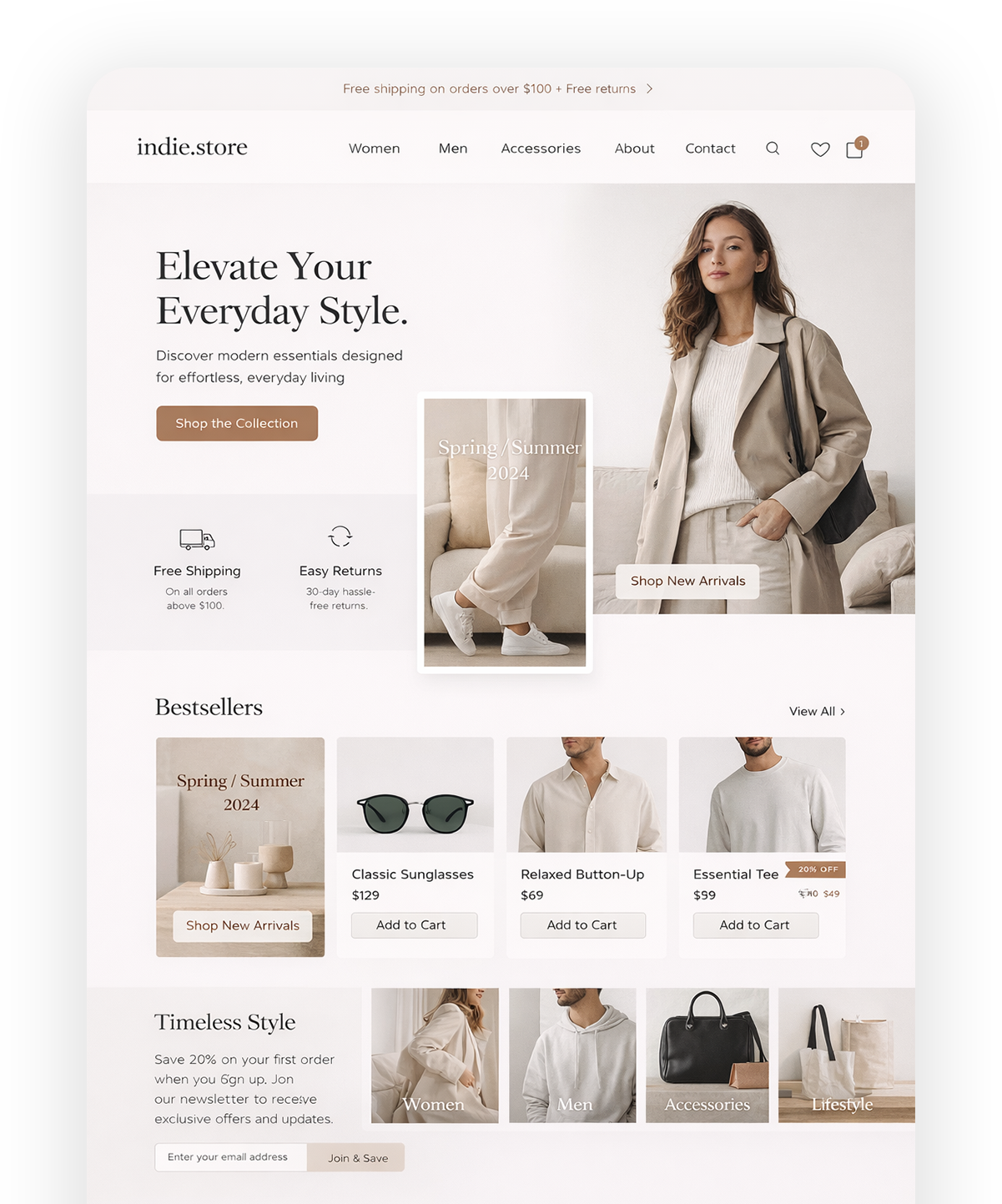
One of the most common mistakes is trying to compress every detail onto the homepage. A high performing homepage is simple, clear, and purposeful. It guides visitors toward the right sections instead of overwhelming them.
A homepage typically includes:
- A clear headline that explains what you do
- A supporting subheading for context
- A brief overview of your key services or categories
- Selected trust elements such as testimonials or client logos
- A short introduction to your approach or experience
- Clear calls to action for primary and secondary paths
This structure helps different visitor types navigate quickly: the person who already knows what they need, the person who wants to explore first, and the person who wants to validate your credibility.
Service and offering pages: where decisions are made
For service based businesses, service pages play the most important role in evaluation. They allow customers to understand what you offer, how your service works, and why you are a suitable choice. Each service page should focus on one clear topic. Trying to combine multiple services into a single page reduces clarity and weakens your message.
Strong service pages usually explain:
- Who the service is for
- What problems the service solves
- What the process looks like
- What outcomes customers can expect
- What strengthens your credibility in this area
Customers should feel that you understand their needs and can provide the right solution.
Portfolio and case studies: proof that builds confidence
Businesses that rely on visual or project based work need strong proof of their capability. Portfolio pages should be easy to navigate, visually clear, and structured around categories when relevant. Each project should include a concise description, high quality images, and enough detail for customers to evaluate your expertise.
Case studies are particularly important for architects, designers, studios, and B2B companies. They allow visitors to understand the challenges, the approach, and the results. When presented well, they increase perceived value and differentiate you from competitors.
About page: positioning, not biography
An effective About page clarifies why your business is trustworthy and relevant. It should focus on positioning rather than personal or organisational history. Visitors look for credibility, experience, and confidence, not long stories.
An About page typically includes:
- A clear description of your value
- A concise overview of your experience or background
- Selected credibility signals such as certifications, recognition, or clients
- A short explanation of your approach or philosophy
This page reinforces your brand and strengthens the impression visitors build during evaluation.
Contact and enquiry pages: remove friction, not add it
Your contact or enquiry page should feel simple and predictable. If you need specific information, request only what is essential. Reducing friction improves the number of enquiries you receive. Providing confirmation messages and clarity about response times further improves trust.
For businesses with booking models, the contact page may transition into a scheduling system. For product based businesses, the focus may shift toward checkout and support pages.
Navigation: the framework that holds everything together
Your menu should reflect the way customers think, not the way your internal files are arranged. A good navigation system considers visitor intent and provides easy paths to:
- Core services
- Proof or portfolio
- Contact or booking
- Informational content for evaluation
- Key categories for product browsing
Navigation should simplify decisions rather than force visitors to guess where information is located.
Why structure planning matters before design
Design brings structure to life, but it cannot fix unclear information flow. A well structured website feels more professional, more stable, and easier to trust. It also reduces future maintenance work because content is organised logically, and updates can be made without restructuring the site repeatedly.
When the structure is clear, designers and developers can build more efficiently. When it is unclear, timelines stretch, revisions increase, and the final result becomes inconsistent.
A thoughtful structure helps your website remain effective as your business grows. It also ensures that visitors can understand your offerings quickly and move confidently toward engagement.
Align platform choice with your revenue model
A simple way to select a platform is to match it with the way your business earns money. Service businesses need flexibility in presentation, structured service pages, and strong enquiry flows. Product businesses need stability in checkout, inventory, and payments. Appointment based businesses need scheduling systems that work reliably. Content heavy businesses need CMS structures that organise information efficiently. Creative businesses need platforms that support visual identity and layout precision.
Choosing a platform based on business alignment rather than personal preference prevents expensive migrations and structural limitations later.
Visibility, Measurement, and Conversion Essentials for a Business Website
A business website creates value only when people can find it, understand it, and take action. Visibility brings the right visitors. Measurement explains their behaviour. Conversion turns those visitors into enquiries, bookings, or sales. These three elements form the operational core of a successful website.
A website with strong visuals but weak visibility does not generate results. A website with good traffic but no measurement cannot be improved. A website that attracts visitors but does not convert them fails its primary purpose. Understanding these concepts at a business level ensures better decisions during planning and development.
Visibility begins with clarity, not shortcuts
Search visibility is not about tricks. It begins with clear structure, focused pages, and content that answers real customer questions. Search engines support websites that are easy to understand and relevant to the search intent behind each query.
A strong visibility foundation is created when each page:
- Covers a single topic
- Uses a logical content structure
- Answers customer questions directly
- Loads quickly and works well on mobile
When your website is organised this way, search engines categorise it correctly and connect it to relevant searches.
Search optimisation relies on simple fundamentals
There are a few core elements every business owner should expect from their website:
- Clear titles describing what each page is about
- Readable, descriptive URLs
- Logical heading structure
- Compressed, accessible images
- Fast loading performance
- Mobile friendly layouts
These fundamentals have more impact than any advanced tactic. They form the base of sustainable visibility.
Measurement turns assumptions into clear decisions
Measurement explains how visitors behave on your website. It shows what they see, where they drop off, and what leads them to enquire or buy. Without it, you cannot evaluate whether your website is doing its job.
Analytics tools such as Google Analytics, Search Console, and Microsoft Clarity help you track:
- Where your traffic comes from
- Which pages attract attention
- Which pages lose visitors
- Which actions lead to enquiries, bookings, or sales
Measurement reveals what needs improvement and what is already working.
Focus on meaningful outcomes rather than surface metrics
Many metrics look impressive but do not influence business results. What matters most depends on your model:
- Service businesses should track enquiries, calls, quote requests, and consultation bookings
- Product businesses should track add to carts, completed purchases, and checkout behaviour
- Appointment based businesses should track completed bookings and booking attempts
Meaningful metrics tell the story of your revenue. Everything else is context.
Conversion depends on structure, clarity, and trust
Visitors convert when they understand what you offer, trust your expertise, and see a clear next step. Conversion improves naturally when the information sequence matches the customer’s decision process.
Three components matter most:
- Clear messaging that explains value and relevance
- Structured pages that guide visitors logically
- Trust signals that reduce hesitation
When these elements work together, visitors move from interest to enquiry with less resistance.
Design influences confidence more than aesthetics
Design creates clarity. It helps visitors understand where to look, what matters, and how to move forward. Clean layouts, readable typography, and consistent spacing create a sense of professionalism. This influences how credible your business feels before visitors read a single sentence.
Trust signals should appear naturally across the site
People want reassurance that they are making the right choice. Trust is strengthened through:
- Project examples
- Testimonials
- Credentials
- Recognised clients
- Awards or results
- A clear explanation of your process
These elements should appear throughout your pages rather than being hidden on a separate section.
Calls to action must be clear and specific
Every website needs a primary action. It should reflect what visitors are ready to do at that moment, such as:
- Book a consultation
- Request a quote
- Call for information
- Make a purchase
Clear, focused calls to action turn interest into action without creating pressure.
Visibility, measurement, and conversion operate together
Your website becomes a reliable business asset when:
- Visitors can find you
- You understand their behaviour
- They can take action easily
These three areas work as a system. When they align with your business model and your website’s structure, the outcome is stable performance and predictable growth.
Launch, Maintenance, and Long Term Website Management
A business website is not complete when it goes live. Launch marks the beginning of its operational life, not the end of the project. Once customers begin using the website, its real purpose becomes clear. Your website must remain stable, secure, accurate, and aligned with your evolving business. Without consistent care, even the best designed websites lose performance over time, become outdated, or develop issues that affect credibility and revenue.
This section explains what business owners should understand about managing their website after launch. You do not need to handle the work yourself, but you should know what to expect from a healthy website and the responsibilities involved in keeping it reliable.
Pre-launch checks ensure a smooth first impression
Before your website goes live, it must be reviewed as if you were a customer visiting it for the first time. The technical setup matters, but the visitor experience matters more. Pre-launch checks confirm that your website works correctly, communicates clearly, and supports your goals from the moment it becomes public.
A reliable pre-launch review includes:
- Ensuring every essential page is complete
- Confirming mobile layouts are readable and functional
- Testing all forms, booking flows, and payment systems
- Checking menu links, buttons, and internal navigation paths
- Reviewing content for clarity, accuracy, and relevance
- Verifying search optimisation basics such as titles, URLs, and alt text
- Installing analytics and testing event tracking
This step prevents early errors and protects the first interactions customers have with your brand.
The first few weeks after launch are critical
Once the website is live, several systems begin working simultaneously. Search engines start indexing pages. Users begin interacting with forms and navigation. Performance reports start generating real data. This period often reveals small adjustments that improve stability and user experience.
During the early post-launch phase, monitor:
- Form submissions to ensure they reach the correct inboxes
- Slow loading pages that may require optimisation
- Search Console reports to confirm pages are indexed
- Errors in navigation or content that were not visible before launch
- Feedback from real users who may interpret content differently
Small adjustments during this phase improve long term performance and prevent recurring issues.
Maintenance protects your website and keeps it functional
A business website requires routine maintenance. Without it, systems become outdated, security gaps appear, and performance declines. Maintenance is not an optional activity. It is a core part of website ownership that protects your investment and your customers.
Healthy maintenance includes:
- Updating plugins, themes, and platform components
- Running security scans to detect threats early
- Monitoring uptime to ensure the website remains accessible
- Creating reliable backups stored in safe locations
- Checking forms, bookings, and transactions monthly
- Reviewing hosting and performance reports
Businesses often underestimate the importance of these tasks. Neglecting them can lead to downtime, lost enquiries, data breaches, or irreversible damage to your reputation.
Security is a long term responsibility, not a one time setup
Every business website, regardless of its size, is a target for automated threats. Security should be reviewed regularly to ensure your site stays protected. A secure website builds trust with customers and prevents disruptions.
Security involves more than installing a certificate. It requires:
- Regular software updates
- Server level protection
- Firewall systems
- Malware monitoring
- Automated daily or weekly backups
- Limited access to administrative areas
Fully hosted platforms handle most of this internally. Self hosted platforms such as WordPress require ongoing oversight. Choosing a maintenance partner who handles these tasks reduces long term risk.
Content must evolve with your business
Your website reflects your business at a point in time. As your services change, your positioning matures, or your customer expectations shift, your content must adapt. Outdated content reduces trust, creates confusion, and weakens search visibility.
Plan for intentional updates that support your growth. These may include revising service descriptions, updating case studies, refreshing prices or processes, adding new locations, or improving frequently asked questions. Even a small quarterly review keeps your content aligned with your business and your customers.
As your business grows, you may also expand into more structured content such as resources, guides, or blogs. These additions support visibility and build authority over time.
Continuous improvement helps your website stay competitive
Your website is an active part of your business operations. It benefits from ongoing evaluation and refinement. Improvement does not require weekly work. It requires a predictable rhythm that allows you to respond to data and maintain relevance.
A practical improvement cycle includes:
- Quarterly content and conversion review
- Twice yearly updates to layout, structure, or messaging
- Annual strategic review based on new services, competitors, and market trends
This approach keeps your website focused on outcomes rather than stagnating after the first launch.
Understanding your support options
Most business owners do not maintain their website themselves. The level of support you choose should match your website’s complexity and your internal capacity.
- Simple websites can be maintained with basic support or light freelancer involvement.
- Mid sized websites benefit from regular maintenance packages that cover updates, security, backups, and small improvements.
- Complex websites with booking systems, e-commerce, or integrated tools require structured ongoing support from a reliable partner.
Support should be predictable, not reactive. A proactive support plan prevents issues rather than responding to emergencies.
Recognising when your website needs a redesign
A redesign is not a cosmetic exercise. It is a strategic decision made when your website no longer reflects how your business operates.
Clear indicators include:
- New services that your structure cannot support
- Outdated layout that reduces credibility
- Slow performance that impacts user experience
- Navigation that feels disorganised or incomplete
- Visual identity that no longer matches your brand
- Declining enquiries or conversions despite traffic
- Tools or systems that cannot integrate with your current platform
A redesign becomes necessary when the website limits your growth or fails to support your customer experience.
A well managed website becomes a long term business asset
When your website is launched carefully, maintained consistently, and improved with data, it stops being a one time project and becomes an ongoing asset. It supports your sales process, reinforces your positioning, strengthens customer trust, and evolves with your company.
A business website creates the highest impact when it is treated as part of your operations rather than as a static brochure. Proper management ensures stability, long term value, and performance that matches your ambitions.
Why does my business need a website if I already get customers through referrals or social media?
Because customers still verify your legitimacy online. A website strengthens credibility, explains your services clearly, and ensures prospects see accurate information before contacting you. It also protects your brand by giving you a controlled, permanent presence.
What is the difference between a good looking website and a high performing website?
A good looking site focuses on visuals, while a high performing site focuses on clarity, trust, and conversions. The latter guides visitors toward taking action through strong content, structure, and user experience.
How do I decide the primary purpose of my website?
Identify how revenue enters your business and match the purpose to that process. If sales start with enquiries, focus on lead generation; if they start with bookings, focus on scheduling; if they involve purchases, prioritise e-commerce.
What is the biggest mistake business owners make when building a website?
They jump into design without first defining purpose, audience, and messaging. This leads to attractive pages that don’t convert because they lack structure and clarity.
Which website type is right for my small business?
Choose a type based on how customers make decisions and pay you. Service providers need lead generation sites, product companies need e-commerce, creative professionals need portfolios, and time-based businesses need booking systems.
How long does it take to build a business website?
Simple sites take one to three weeks, structured service websites take four to six weeks, and sites with bookings or e-commerce take six to twelve weeks. Custom or complex builds extend beyond that due to design, content, and integration requirements.
How much should I budget for a new website?
Budget for three categories: platform costs, build costs, and ongoing maintenance. Simple sites sit in lower ranges, starting from 10-12K INR, while e-commerce, booking systems, and advanced features require higher investment starting from 75-80K INR.
Should I choose a DIY builder, freelancer, or agency?
DIY is best for basic sites with tight budgets. Freelancers suit medium complexity with custom layouts, while agencies deliver the most strategic, scalable, and full-service builds for businesses with higher expectations.
Which platform is best for business websites?
WordPress suits most service and content-heavy websites including e-commerce due to its flexibility, while Shopify is only ideal for e-commerce websites needing quick setup. Wix, Squarespace, and Webflow work for simpler or design-heavy websites depending on your long-term needs.
How do I plan content for my website?
Start with a page inventory, define each page’s purpose, and outline the decisions visitors should make there. Write content that follows a clear flow: context, problem, solution, proof, details, and action.
Is SEO important when building a business website?
Yes, because it ensures your website can be found by people actively searching for your services. At minimum, you need clear page topics, proper headings, descriptive URLs, optimised images, and good mobile performance.
What should I track after launching my website?
Monitor visitor sources, top pages, and conversion actions like form submissions or bookings. This helps identify which pages work, which need improvements, and how well your website supports revenue.
How often should I update my website?
Perform basic updates monthly and review core pages quarterly. A full structural or design review once a year ensures your website continues to match your business and customer expectations.
What makes a homepage effective for business websites?
It should explain what you offer, who you serve, and why you are trusted within seconds. It must guide visitors toward relevant service pages and display clear proof and a primary call to action.
How do I ensure my website grows with my business?
Choose platforms and tools that scale easily and avoid overly custom setups that lock you in. Review your website regularly to make sure your content, services, and structure still support your current operations.